Beautiful Worlds
Thoughts on the panel I chaired at this year's YALC event, and how we build worlds best when we trust the reader.

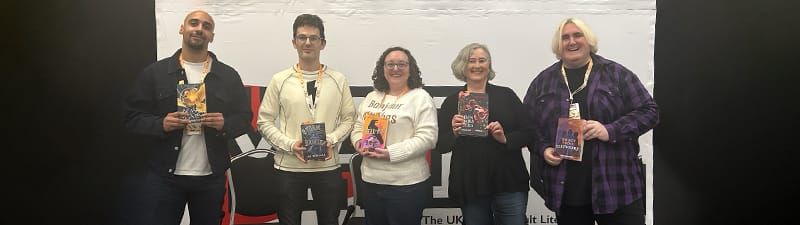
One week ago, at the Young Adult Literature Convention, I chaired a panel called Beautiful Worlds during which we talked about world building in YA fiction.
Between my guests we had heists in the afterlife, supernatural storms, magical families, and two sisters sharing one body. If we’d gone into the level of depth I wanted to on all of those incredible stories, we might still be sat there now.
The books were Hell to Pay by Lora Beth Johnson, Storm Bringer by Tig Wallace, Seven Deadly Spells by L.A. Weatherly, and Beastwoven by A.B. Hamilton. It was such a pleasure to get these brilliant authors together to talk about how they make the worlds they build in their books feel real.
These were four different authors telling four very different stories, and yet they all agreed on one key point: the world you build has to serve the story and the characters, not the other way around.
I love discovering how an imagined world works. Give me strange weather, unfamiliar magic, and a place with a history that reaches beyond the edge of the page. But there’s a difference between discovering those things alongside a character, and being asked to sit through several chapters of explanation before the story actually begins.
Personally, I think that the details of a world become much more interesting when they matter to somebody. What can a character do in this world that they couldn’t do in ours? What are they forbidden from doing? Who made the rules, and what happens when someone breaks them? You can learn a great deal about a place by watching the people in it try to live their lives.
That was what I enjoyed most about the discussion with the panel. Four authors had imagined very different possibilities, yet none of them treated the setting as something to admire from a safe distance. Their characters have to move through these worlds, make choices inside them, and live with what follows. Even the most extraordinary idea has to meet a person somewhere.
There’s room for lore, of course. I’m an author. I know how satisfying it is to work out a detail that might never make it onto the page. But the reader doesn’t need the full contents of our notebooks. They need enough to find their way in, and people they want to follow once they’re there.
As I've written about before: it's simply a matter of respecting the reader.
I'm so grateful for Aaron, Tig, Lee, and Lora Beth for sharing their time, wisdom, and enthusiasm during the panel, and can't wait to see more of the beautiful worlds that they are building.
Until next time,