On This Day...
Something big happened on the 23rd of June. That's right! It's... Alan Turing's birthday! Oh, you thought I meant the other thing? Well...

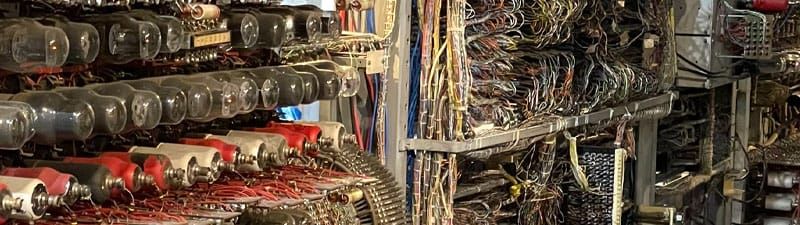
It is the 23rd of June. For those of us who live in the UK, this is a significant day in history. A day of legacy, consequence, invention, identity, and the slow realisation that something once set in motion cannot easily be put back in the box.
I am talking, of course, about Alan Turing’s birthday.
Born on the 23rd of June back in 1912, Turing was one of the great minds of the 20th century. He was a mathematician, a codebreaker, a philosopher, a pioneer of computing, and one of those people whose work changed the world without the world even knowing who, when, where, why, or how.
We all live in his legacy. Every time we use a computer, ask a machine a question, argue about artificial intelligence, or place more trust into a password field than we ever should, we are moving through a world Turing helped make possible.
Alan Turing was also hideously persecuted in his lifetime for having the audacity to be himself and not be particularly secretive about that fact.
He was a gay man who lived at a time where that was not a legal thing to be. People knew, but operated a sort of don’t-ask-don’t-tell policy because the work that he was doing was important and necessary. Once that stopped being the case, tolerance ran out fast. He was subjected to the kind of treatment that we would now rightly see as barbaric, punished by the very society he helped protect. Years later, of course, we’ve tried to repair the wound with honours, apologies, banknotes, statues, and the language of national pride.
I am glad he is remembered. I am sad at the way he was treated.
But at least times have changed, right?
Alan Turing and his team helped to stop the tide of fascism from taking over Europe and the world - and yet the world is more divided than ever.
Perhaps, then, we should focus on that other really divisive thing that happened in the UK on the 23rd of June. I’m talking, of course, about The Battle of Bannockburn.
As an English migrant living in Scotland, I’m keenly aware that there’s a lot of history between our two nations. On this day 7.12 centuries ago, a keen Scots army saw off a much larger English invasion force. You see, Scottish independence was the hot topic on the table in the year 1314, and the Battle of Bannockburn proved once and for all that Westminster could never block a Scottish bid for independence ever again. Apparently.
I guess that’s the thing about big events. They do not end when they end. A battle is not only mud, blood, horses, and people making terrible decisions in uncomfortable clothing. Songs get written and sung. Monuments get built. Stories get told.
This is not necessarily bad. We need stories. They are how we carry meaning across time without having to hold every fact in our hands at once. But stories are powerful, and power is rarely tidy. A story can strengthen people. It can also trap them. It can become a shelter, a banner, a weapon, or a habit. Sometimes all four before breakfast.
So here we are, on 23 June, surrounded by anniversaries. A birth that helped shape the digital world, and a battle that helped shape the story of a nation. Two very different kinds of legacy, but both of them very human.
Both outliving the specific moments that made them.
There is another thing that happened on 23 June. One that some people celebrated, some people grieved, and many are still trying to understand in the small print of daily life.
I stayed up all night to watch the results come in, and went from hopeful to confused to angry to sad to tired. I wondered if this would be a defining moment, whether life would ever feel the same again. And then, the next day, it was back to shopping and writing and working and the minutiae of everyday life. You could almost be forgiven for thinking it wasn’t that world-changing after all.
But it was. It mattered. It has echoes everywhere, and every day. But I am also trying to remember, as we hit this big anniversary, that no single day gets the final word on who we are. Not even the days that shake us. Especially not the days that shake us.
A day can last much longer than twenty-four hours. It can echo for decades, centuries, or just long enough to teach us something we were not ready to learn at the time.
But sooner or later, we have to decide what we are going to build in the echo.
Solidarity forever.