Rewilding The Web
On the thirty-fifth birthday of the World Wide Web, I share some thoughts on reclaiming the playground I grew up in.

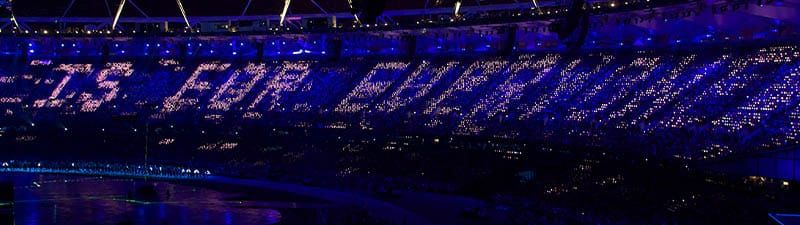
Happy birthday, World Wide Web! The first ever website went online thirty-five years ago this week - no images, no animation, no fanfare. Just a set of hyperlinks, a bunch of pages explaining what the web is, and a promise: universal access to information.
Sir Tim Berners-Lee would repeat this sentiment many times over the years, but never more simply than in a message he sent from the stage at the opening of the 2012 Olympic Games in London:
This is for everyone.
The early web was not impressive by today's standards. It wasn't full of slick parallax backgrounds or fancy animations, but it was brilliant because it could be... well, anything. Nobody really knew what to do with it, so people tried things. Some of those things were useful, some were experimental, and some were hideous collections of flashing text that probably caused permanent retinal damage. It was brilliant, imperfect and, most importantly, unfinished.
I grew up alongside it, using the web as a sort of extended playground for whatever I happened to be interested in that week. I wrote things and made music, recorded parody songs that nobody had asked for, and hacked together websites without worrying whether I was doing any of it properly.

It was also where I made friends and built relationships, back when people still felt the need to distinguish between “internet friends” and real ones, as though the people on the other side of the screen were elaborate pieces of software. The web opened up a world far beyond the one immediately around me and let me find people who shared my interests, my sense of humour or simply my particular flavour of strangeness.
I remember the first time I met an "internet friend" in real life (or IRL, as we called it back then). We met at a bowling alley, and I had to use the payphone to call off the three friends I had on standby, just in case they turned out to be gay-bashing fascists ready to jump me the moment I bent over to tie my bowling shoes. Thankfully, they weren't.
But, sadly, the web also introduced me to plenty of hatred.
Some of it was directed at me, or at people like me, and some of it became part of the way I saw myself. The freedom to discover that there were other ways of living also came with the discovery that a great many people despised us for them. The web did not liberate us from the prejudices of the world outside. It gave those prejudices their own websites, blogs, and chat rooms.
This is why I am wary of talking about the early web through rose-tinted glasses. Yes, it was a playground, but think back to your school days. The playgrounds you hung out on at break time were not necessarily a safe place either. They could can contain friendship, invention, and cruelty, all within the same small patch of tarmac. The web was much the same. What it offered was space. If one part of the playground was hostile, there was usually another corner where you could exist, often alongside a peculiar collection of people making something nobody else quite understood.
Over time, those corners became harder to find.
Nothing changed overnight - but, before too long, the school playground acquired sponsors. Then fences. Then advertising hoardings, market stalls and a surprisingly officious security team telling us what we were and were not allowed to build.
Commercial activity on the internet is hardly new, and I am not opposed to people being paid for their work. I am, would you believe, one of those irritating people who thinks writers should be able to afford food.
But when the web became more e-commerce than effervescent eccentricity, our online lives started to get concentrated inside a handful of privately owned spaces, with rules we did not write and purposes that had very little to do with helping us create or connect.
The things we made became “content”. Our relationships became “engagement”. Our attention became an asset to be captured, measured and sold, while the platforms kept insisting that all of this was being done to bring us closer together.
There is a peculiar indignity in being invited to express yourself freely inside a box designed by a product manager, especially when the box keeps changing shape to accommodate more advertising, and the product manager keeps jumping through hoops to please a boss that doesn't even know what a box is meant to look like.
We paved paradise and put up a parking lot.
A very convenient parking lot, admittedly, with same-day delivery and an endless stream of videos selected specifically to prevent us from ever leaving the car, but still a parking lot.
Thankfully, life always finds a way - and, if you know where to look, you can see beautiful things growing through the cracks in the concrete.
Beyond the brightly lit platforms, people are still building their own corners. The tildeverse, the small web and countless personal sites and independent communities are being maintained by people who have not forgotten that the internet can be something we make together. Hackers are still hacking away, not because every project needs to become a product, but because sometimes a thing should exist simply because somebody wants it to.
These are not merely nostalgic reconstructions of an internet we have lost.
Another kind of web remains possible.
As nostalgic as I get sometimes, I do not want to simply recreate the web of the 1990s. It wasn't always accessible, it didn't render in every browser, and, frankly, I'm no longer willing to wait several minutes for a photograph to load one horizontal strip at a time.
What I want, desperately, is to recover the sense that the web belongs to the people using it. It can be collaborative, collectively owned and operated, vibrantly beautiful, and beautifully messy. A web where, if the thing we need does not exist, we are simply allowed to build it.
Rewilding the web means creating spaces that do not treat every human interaction as something to be monetised. It means making things for small audiences, or perhaps for no audience at all. It means remembering that a website does not need a growth strategy, an exit plan or a compelling reason for venture capitalists to care about it.
Sometimes it can just be a place where you put something you made.
Thirty-five years ago, Tim Berners-Lee sat at a computer and showed us what the future could hold. After three-and-a-half decades of bulldozing, corporate consolidation, venture capital and consumerism-led design, that original promise still remains.
The World Wide Web is still for everyone. We just need to start acting as though we believe it.