
It's About Time
Thoughts on the absurdity of daylight savings, the redundancy of timezones, and whether it's time to burn the clocks.

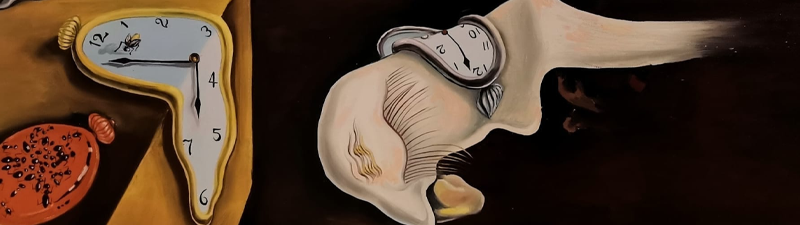
What if opposite day became legally binding? What if, every other Thursday, the floor was actually lava? And what if we decided en masse to declare 2am is actually 1am?
Oh. Wait.
Here we are again. It's that time of year where we wake up one morning, declare that something is now in fact something else, and act as if this makes perfect sense.
We move the clocks. We lose an hour. Or gain one. We feel vaguely jet-lagged for a few days, and then carry on as though none of this is deeply ridiculous.
It is absolute nonsense.
Growing up, I was taught that time was immutable. It was a universal constant - something precise and scientific and sensible. Imagine my confusion when I realised that, really, "time" as we measure it is a complete fabrication.
It's just humans pointing at the sky and saying, sure, that'll do. Sixty minutes in an hour. Twenty-four hours in a day. Except sometimes not because reasons.
Daylight savings time feels like the purest example of this collective delusion. A reminder that our relationship with time is less physics and more theatre. It's chaos.
And I fucking love that.
Because once you accept that time is mostly based on ancient vibe checks, you realise how bendy it really is. We watch science fiction, where time stretches, snaps, loops, and is exhaustingly still called "timey wimey" by whovians everywhere. But that Tenth Doctor quote is actually strangely accurate. Time is absolute fiction. A single moment can take three pages. Ten years can disappear in a heartbeat. Yesterday can haunt today.
It turns out time is not a solid structure. It's more like soft clay, vaguely spinning on a never-ending wheel.
Wait. No. Sorry. That's The Thomas Crown Affair.
Time defies measurement.
It's completely subjective. And yet we measure it, because that's a genuinely helpful thing to do. Yet we can't. But we can. Yet we... It'll drive you mad if you think about it too much - which is probably why we've stuck with oddities like Daylight Savings for so long. If you unpick that, then what's to stop us from burning the whole system of measurement down and starting again?
Which brings me to one of my favourite, gloriously odd ideas from the late 90s. Back when the world was full of Tamagotchis, translucent plastic gadgets, and the comforting screech of dial-up, the concept of Internet Time was proposed by watchmaker Swatch.
I first stumbled across it thanks to my friend Jessica about a decade ago, and have been quietly in love with it ever since.
One planet. One clock. The day split into 1,000 little units called beats. No daylight savings. No “is it 7pm here or 9am there?” nonsense. Just a universal beat going on, blissfully unaware of national borders or seasonal clock-fiddling. Like a stardate, but real.
It is slightly bonkers. Which is exactly why it is brilliant.
And I'm not the only fan. Jessica has built the incredible Internet Ti.Me website and an accompanying app called @watch that lets you actually live in Internet Time if you are so inclined. I dip back into it every now and then like a favourite sandwich - not to be made too often, but to be savoured when it is.
Back in 1999 the idea of changing a system so big, so prevelent in society seemed impossible. It's for this reason that Internet Time never really took off. But the further into the '20s we get, the more this era seems to be defined by collapsing systems and "unprecidented" scenarios.
So why don’t we just... burn all the clocks? We could just change the system. Change time. The more absurd everything else becomes, the less absurd that idea starts to feel.
Time is not sacred.
It is invented. Negotiated. Held together with duct tape. If we can collectively agree, twice a year, to wake up and pretend that we've gone forward or back an hour, then perhaps we can agree to something better. Or stranger. Or at the very least, more honest about the fact that this whole thing is entirely performative.
I fear, sadly, that we'll continue on the path of least resistence. Twice a year we'll keep moving the clocks. Keep pretending this makes sense. Keep arguing about whether we have lost an hour or stolen one.
But deep down, I will remain quietly in love with the idea that somewhere, lurking since 1999, is a gloriously weird alternative that feels less ridiculous every year.

With thanks to my friend Leo, who this week taught me what a pottery wheel is and as such inspired a whole metaphor above.